
How to Check RC Status Online in 2026
By Sanya Khorana
Contents
How to Check RC Status Online in 2026: Updated Process, Documents & Common Errors
Introduction
Vehicle documentation in India has evolved rapidly over the last few years, with most services shifting to digital platforms. Among these, checking the Registration Certificate (RC) status online has become one of the most essential and frequently used tasks for vehicle owners. Whether someone is verifying ownership, tracking an RC transfer, renewing insurance, or simply confirming the validity of their vehicle documents, the online RC status check saves time and eliminates long RTO visits.
In 2025, the government has strengthened digital systems like Parivahan, DigiLocker, and state-level transport portals. This article breaks down the updated process, the documents required, and the common errors users face while checking their RC status online. Readers will also learn how different methods compare, what affects accuracy, and how to fix typical issues, ensuring a smoother, faster, and more reliable process.
Rise of Digital Vehicle Services in India
Since 2022, India has witnessed a major shift toward the digitalization of vehicle-related services. Increased smartphone access streamlined government platforms, and the need for instant verification has significantly changed how people manage their vehicle documents. Services like RC checks, challan updates, insurance renewals, fitness validity checks, hypothecation removal, and PUC verification are now commonly accessed online.
The Government of India has integrated multiple state RTOs into central databases like Vahan 4.0, making online RC status checks far more accurate and accessible. Private apps and portals further simplified the experience by offering unified dashboards for all vehicle data. As a result, the focus has shifted from physical documentation to instant digital availability, where accuracy, transparency, and speed are the new differentiators, especially for buyers and sellers of used vehicles.
Why Checking RC Status Matters
For vehicle owners, the RC is more than a document; it represents legal registration and the right to operate a vehicle. Checking its status online ensures that the RC is valid, updated, and reflects accurate details. It’s particularly important during situations like buying or selling used vehicles, where verifying ownership, hypothecation, and past challans becomes essential for avoiding fraud.
Additionally, an updated RC helps avoid penalties related to expired documents, mismatched ownership details, or missing fitness certificates. For many drivers, instant access to RC status is useful in daily scenarios such as renewing insurance, verifying emission test compliance, or confirming whether a transfer request has been processed. Online tools now allow users to track all this information in real time, making it easier to stay compliant and protect themselves from unexpected penalties or delays.
Key Factors That Affect RC Status Updates
Although online systems have improved significantly, several factors still influence how quickly and accurately RC status updates appear online:
• RTO Processing Time
Even with digitisation, certain state RTOs take longer to process RC transfers, hypothecation removal, or address updates.
• Database Synchronisation
Details updated at the RTO may take 24–72 hours to reflect on the Parivahan system, depending on data sync schedules.
• State-Level Transport Systems
Some states still operate partially independent systems, causing delays or incomplete visibility of vehicle details.
• Incomplete Documentation
If a user submits incorrect forms or missing documents during RC transfer or renewal, the process may be put on hold.
• Server Load & Maintenance
Government portals often experience downtime, especially during peak hours or maintenance cycles.
• Internet or App Errors
Slow networks, outdated app versions, and incorrect vehicle numbers can impact the results displayed.
Understanding these factors helps users know why RC results may vary across methods or appear delayed.
Platform-Wise RC Status Check Comparison
To make checking RC status easier, several reliable platforms are available in 2025. Each offers different levels of speed, accuracy, and information depth. Here is a detailed comparison of the major platforms:
Parivahan Portal
The Ministry of Road Transport & Highways (MoRTH) runs the Parivahan/Vahan portal, the most used method for checking RC status.
Average Response Time: Fast during non-peak hours
Accuracy: High, directly synced with RTO data
Best For: Official information
Insights:
- Offers owner details, registration validity, fuel type, insurance expiry, challans, and fitness status.
- Works consistently across most states.
- May slow down or show “Server Busy” errors during peak usage.
Overall Verdict: Reliable and official — ideal for quick verification.
State RTO Websites
Some states, like Maharashtra, Karnataka, and Delhi, have independent RTO portals.
Average Response Time: Moderate
Accuracy: High but limited to state databases
Best For: Location-specific RC updates
Insights:
- Useful for RC transfers, NOC status, and fitness updates.
- May lack cross-state data visibility.
Overall Verdict: Good for state-level services but not always comprehensive.
DigiLocker / mParivahan App
These government-backed apps allow users to access digital RC copies.
Average Response Time: Instant
Accuracy: Depends on prior document linking
Best For: Accessing digital RC on mobile
Insights:
- Shows a digitally signed RC, legally accepted across India.
- Does not always reflect real-time updates unless manually refreshed.
Overall Verdict: Great for carrying RC, but not the best for tracking updates.
Third-Party Vehicle Information Apps
In 2025, several apps will allow users to check RC status, challans, insurance, and FASTag information.
Average Response Time: Very fast
Accuracy: High, but it depends on backend sources
Best For: All information in one place
Insights:
- Ideal for buyers and regular vehicle users.
- Offers additional features like insurance checking, challans, and reminders.
Overall Verdict: Convenient, fast, and user-friendly, suitable for everyday checks.
Summary Table
| Platform | Speed | Accuracy | Best For |
| Parivahan | Fast | High | Official RC data |
| State RTO Sites | Moderate | High | State-level RC updates |
| DigiLocker/mParivahan | Instant | Medium | Carrying digital RC |
| Third-Party Apps | Very Fast | High | Quick checks & extra details |
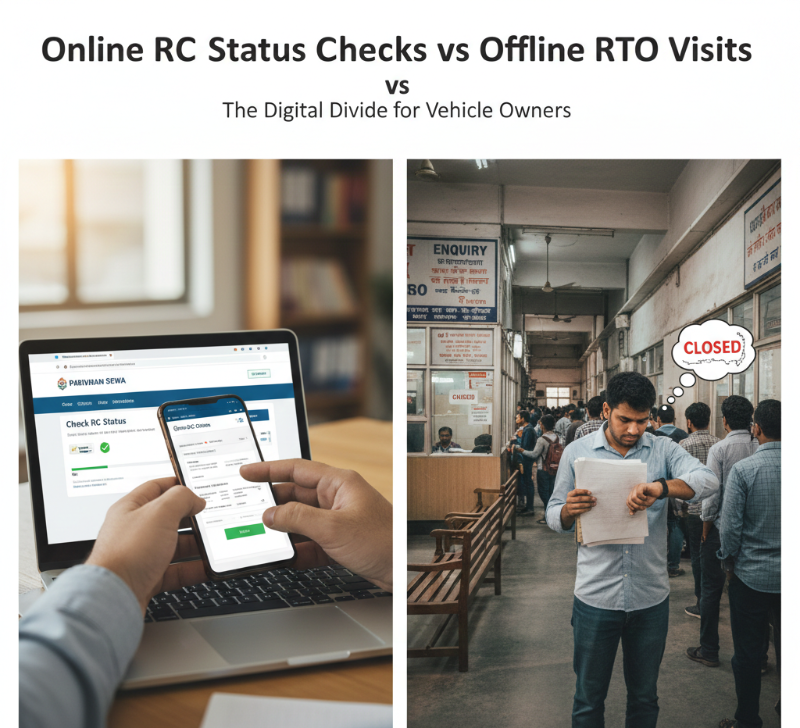
Online RC Status Checks vs Offline RTO Visits
The biggest advantage of checking RC status online is avoiding long queues and inconsistent processing at RTOs. Online platforms offer instant access to details like ownership, hypothecation, challans, and fitness validity data that previously required physical visits and manual verification.
In contrast, offline RTO visits involve form submissions, document scrutiny, and follow-ups, which may take several days. The online method eliminates physical paperwork, reduces human error, and provides real-time visibility of updates. While certain services like physical inspection or original RC card reprinting still require a visit, most routine checks can now be completed quickly online, saving significant time and effort.
Why Online RC Status Checks Are Getting More Accurate
Several improvements have made online RC checks more reliable in 2025. The integration of Vahan 4.0, improved API connectivity, and mandatory digital documentation have strengthened data consistency across states. Insurance companies, PUC centers, and enforcement systems now sync their databases more frequently, reducing the chances of outdated records appearing online.
Real-time challan systems have also improved transparency. If a challan is issued through an ANPR camera or e-challan system, it automatically reflects in RC-related portals. Additionally, vehicle owners now receive SMS alerts for RC transfers, fitness updates, and ownership changes, further boosting accuracy.
These improvements make online RC checks trustworthy for verifying documents during resale, loan processing, or transfers.
Tips to Avoid RC Status Errors
To ensure smooth and accurate RC status checks:
- Always enter the registration number in the correct format (e.g., DL 3C AB 1234).
- Avoid checking during peak hours when government portals face load issues.
- Ensure your digital RC is linked correctly in DigiLocker.
- Keep track of updates after RC transfer, hypothecation removal, or address changes.
- Make sure insurance, PUC, and fitness certificates are renewed on time.
- Regularly check for pending challans, as they may affect certain RC processes.
These small steps help maintain accurate records across all platforms.
Conclusion
Online RC status checking has become faster, more accurate, and more user-friendly in 2025. With multiple platforms offering instant access to vehicle information, users no longer need to visit RTOs for routine document verification. Understanding the updated process, knowing what affects data visibility, and following best practices ensures smooth, error-free checks. Whether you’re verifying ownership, tracking a transfer, or ensuring compliance, online RC status tools provide a reliable and efficient way to stay updated and avoid penalties.
FAQs
1. How can I check RC status online in 2026?
You can check RC status through Parivahan, state RTO portals, DigiLocker, mParivahan, or any trusted vehicle information app by entering your vehicle number.
2. What details appear when checking RC status?
Owner name, registration date, validity, fuel type, vehicle model, hypothecation status, insurance expiry, fitness certificate validity, and pending challans.
3. Why is my RC status not showing updated details?
It may take 24–72 hours for recent updates to sync from the RTO to online systems. Server delays, incomplete documentation, or incorrect numbers may also cause issues.
4. Is the digital RC shown in DigiLocker valid?
Yes, the digital RC issued in DigiLocker is legally valid across India under the IT Act and Motor Vehicles Act.
5. Do I need a physical RC if I have the digital version?
A digital RC is generally sufficient during checks, but a physical RC is still required for certain RTO-level services or interstate transfers.